School of Diving Surges Training
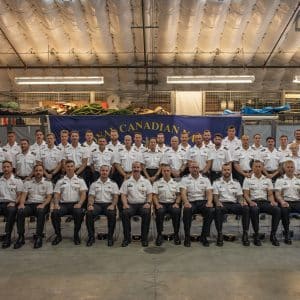
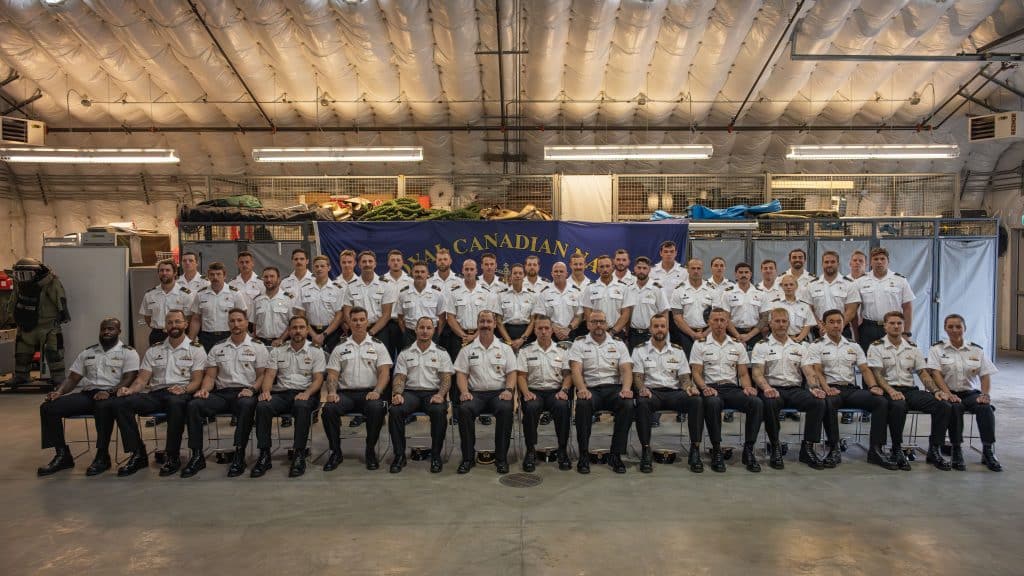
Lt(Navy) Michael Cormie, Fleet Diving Unit (Pacific) Fleet Diving Unit (Pacific) is currently training two concurrent classes of RQS1 Clearance Divers, with a record of 19 students currently enrolled. The 13-month course prepares divers for complex, real-world operations through intensive training in diving systems, fleet support skills, and more. Despite infrastructure challenges and ongoing reconstitution, the School of Diving is adapting to rebuild capacity and deliver highly trained clearance divers. - Petty Officer 2nd Class (PO2) Paul Paquette has his work cut out for him. He is the course instructor for one of two classes of RQS1 Clearance Divers being run concurrently at the School of Diving at Fleet Diving Unit (Pacific) (FDU(P)) this year. A record-high number of 19 students started their training in October 2025, aiming to graduate the high-intensity, thirteenmonth course in late October 2026. PO2 Paquette will help them get there. Shortly after the courses began, students were on parade for the graduation of 2025’s class of divers. “The training is very much a marathon,” said Paquette. “So I hope being on parade helped them visualize what they are working towards when they graduate next year.” Over the duration of the course, the students will learn to dive with various types of diving equipment including the Compressed Air Breathing Apparatus, Surface Supplied Diving, and the two types of rebreather. In addition to the diving itself, students will learn other vital skills including rigging, driving various vehicles and boats, and operating recompression chambers. They will also cover introductory skills in Explosive Ordnance Disposal (EOD) at the Canadian Forces School of Military Engineering in Gagetown. Students will also be introduced to methods of searching for, identifying, destroying, and/ or recovering naval mines that have been rendered safe. They will also learn how to provide engineering support to the...
The Importance of Conduct After Capture (CAC) Training and Becoming a CAC Instructor
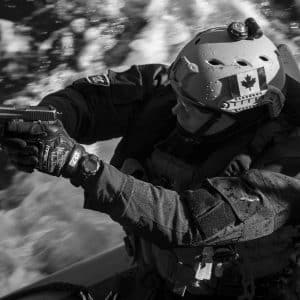
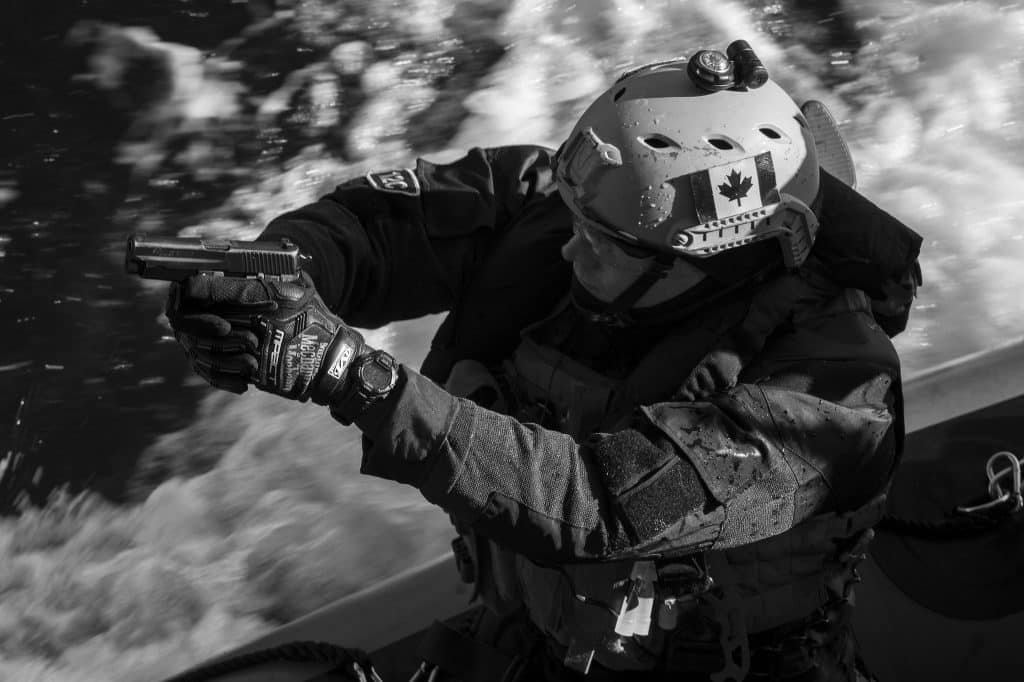
Bordie Lawrence, CAC Training Centre Conduct After Capture (CAC) training equips CAF members with the skills needed to survive captivity, resist exploitation, and deny adversaries critical intelligence. Rooted in real-world case studies and modern conflict realities, CAC training has evolved to meet today’s complex and unpredictable battlespace. CAC Instructors (CACIs) play a vital role in delivering this training, strengthening international partnerships, and preparing peers for the most extreme operational scenarios. - Following the events of Sept 11, 2001, and the commencement of the Global War on Terror, it became clear that Canada’s Tier 1 Unit, Joint Task Force 2 (JTF 2), needed new specialized training for personnel deploying overseas. This training would ensure survivability in captivity, deny the enemy valuable military intelligence, and minimize the exploitation of isolated personnel. As such, JTF 2 members began Resistance to Interrogation (R2I) training to meet this critical need, with support from the British military. By 2005, the first Canadian R2I Instructor Course had been conducted, staffed by British R2I instructors, to fully qualify a pool of Canadian Armed Forces (CAF) members to hold the R2I qualification. This enabled Canada to begin delivering R2I training independently. The first Canadian-run R2I course was held in 2006, staffed entirely by Canadian instructors. The title of instructor was then officially renamed Conduct After Capture Instructor (CACI). In 2008, the Conduct After Capture Training Centre (CAC TC) was formally established in Kingston, ON, under the Canadian Defence Academy. The program continued to evolve, and in 2019, a comprehensive review led to changes designed to adapt training to the modern global climate, taking into account events such as the annexation of Crimea and the increasingly complex battlespace. The updated program went live in 2021 and continues to adapt to today’s challenges, including the invasion of Ukraine in 2022 and Canada’s ongoing commitments to NATO missions. Canadian CAC training has always been informed by real-world events and case studies of personnel being held in captivity....
Reunited After Decades: Korean War Shipmates Reconnect in Retirement
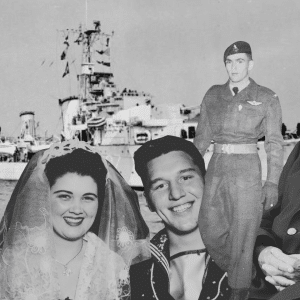
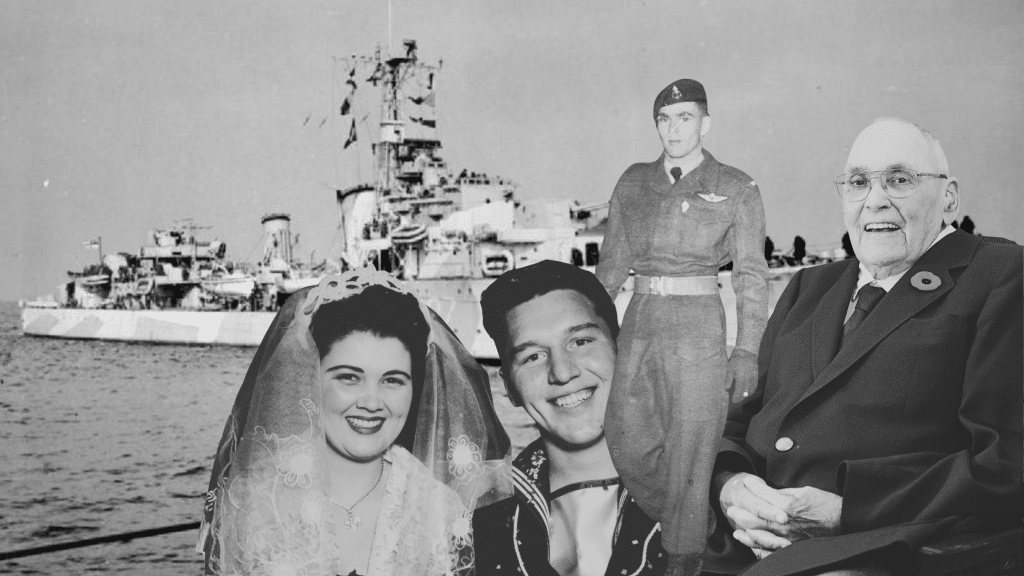
Archana Cini, Lookout Newspaper Three former Royal Canadian Navy (RCN) sailors who served together as teens during the Korean War reunited unexpectedly in their 90s at the Veterans' Lodge, a Broadmead Care home. The men shared memories of life aboard His Majesty's Canadian Ship (HMCS) Athabaskan II, from demanding boiler room work to long months at sea. Their reunion offered a powerful reminder of service, sacrifice, and the lasting bonds formed at sea. - For Roy Mackay, Gil Russell, and Don Russell, life in the Royal Canadian Navy (RCN) as teens meant hard work and discipline. Almost eight decades later, life would give them an unexpected gift — a sudden reunion of shipmates now in their nineties. Now 92, 95, and 94 respectively, (Gil and Don are unrelated, and Don passed away shortly before being interviewed) the three reunited at Victoria’s Broadmead Care Society for the first time in decades. The last time they saw each other was when they were only 16, 18, and 19, serving aboard His Majesty’s Canadian Ship (HMCS) Athabaskan during the Korean War, a vessel often nicknamed ‘Athabaskan II’ or ‘Athabee’. A Tribal-class destroyer, Athabaskan II deployed on three wartime tours starting in 1950 with duties ranging from antisubmarine patrols to troop transport, evacuations, and bombardments. The vessel was in service to Canada from 1948 to 1966. Gil, Roy, and Don all deployed together during its third wartime tour, working as stokers in the boiler room. “I was glad to get out of the army and into the navy, you know,” said Roy. “The navy actually helped me find a job during my return to civilian life, and that was really important to me.” Roy shared details of his work once aboard Athabaskan II for his first deployment with the RCN. “It was freezing down...
Home for the Holidays: HMCS Max Bernays Returns After Historic Deployment
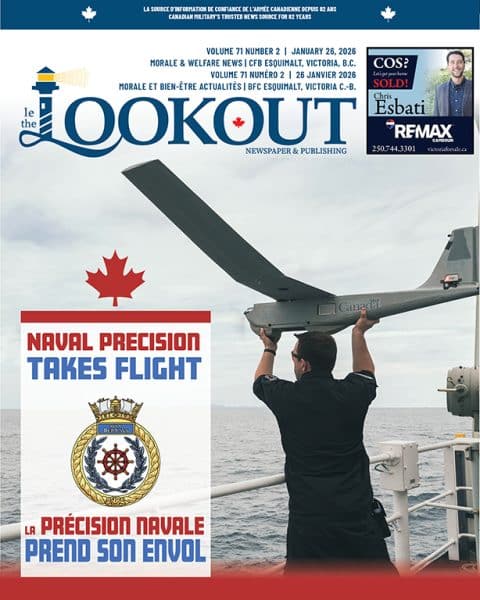
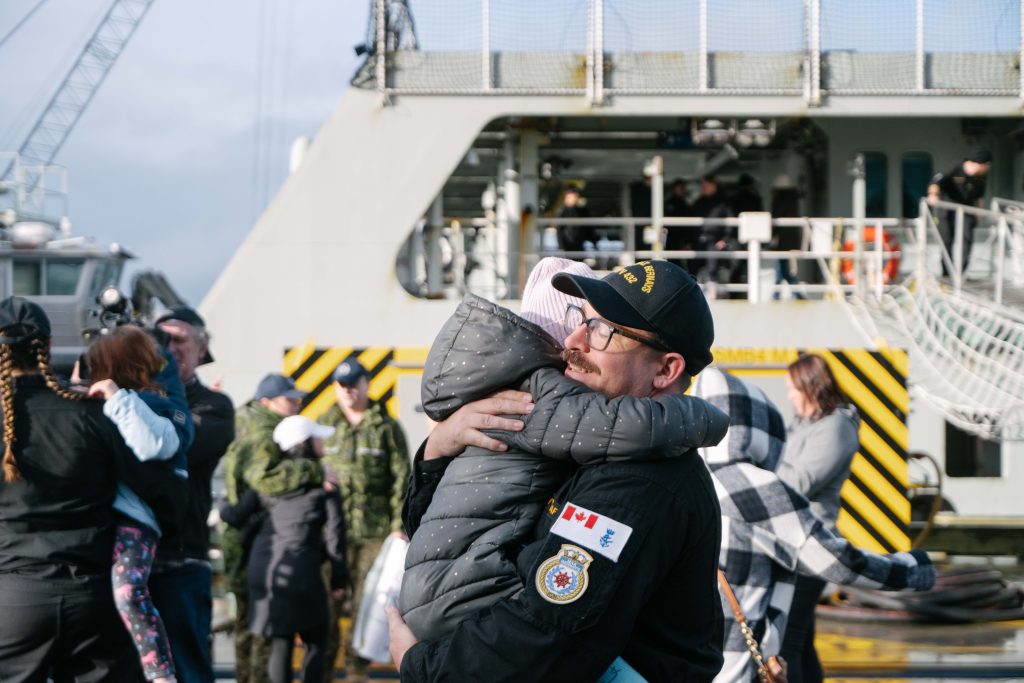
Kelley Stark, MARPAC PA His Majesty's Canadian Ship (HMCS) Max Bernays returned home on Dec 19 after a four-month deployment spanning the Arctic and Indo-Pacific under Operations LATITUDE, HORIZON, and NEON. The ship made Royal Canadian Navy (RCN) history by reaching 81° North, the furthest north ever sailed by a Royal Canadian Navy vessel, reinforcing Canada’s Arctic sovereignty. - His Majesty’s Canadian Ship (HMCS) Max Bernays sailed into its home port on Dec 19, marking the end of a four-month deployment that spanned the Arctic and Indo-Pacific regions under Operations (Op) LATITUDE, HORIZON, and NEON. The crew and their loved ones were thrilled to be reunited. Even the weather seemed happy to see them together as the sun came out on a rather rainy day just as the crew disembarked. Rear-Admiral (RAdm) David Patchell, Commander of Maritime Forces Pacific (MARPAC) and Joint Task Force Pacific ( JTFP), was on the jetty to welcome them home, stating, “It is a crew of exceptional sailors supported by absolutely amazing families,” he said. “They’re home in time for the holidays for a well-deserved break.” The Harry DeWolf-class Arctic and Offshore Patrol Vessel (AOPV) made history during Op LATITUDE by reaching 81° North, the farthest north any Royal Canadian Navy (RCN) vessel has ever sailed. This milestone demonstrates Canada’s growing ability to operate in the High Arctic, and reinforces our sovereignty in a region of increasing global importance. “It is incredible. It is barren. It is breathtaking,” said Commanding Officer of the ship, Commander Nadia Shields. “It is ice as far as the eye can see, and I would say that the Arctic is something that we definitely need to protect.” Following its time in the Arctic, Max Bernays sailed to the Indo-Pacific, visiting ports in Alaska, Hawaii, Japan, the Philippines, and South Korea...


Community Musical Jam
January 28, 2026

Formation 5km
January 30, 2026
Community Musical Jam
February 4, 2026
CFB Esquimalt: A Historic Naval Base Anchoring Canada’s West Coast
Reach out to Lookout Newspaper
"*" indicates required fields
Share Your Navy Story
Do you have a story about life at CFB Esquimalt or experiences with Canada’s Navy? We’d love to hear from you! Share your unique perspective and contribute to preserving the legacy of our naval community.